
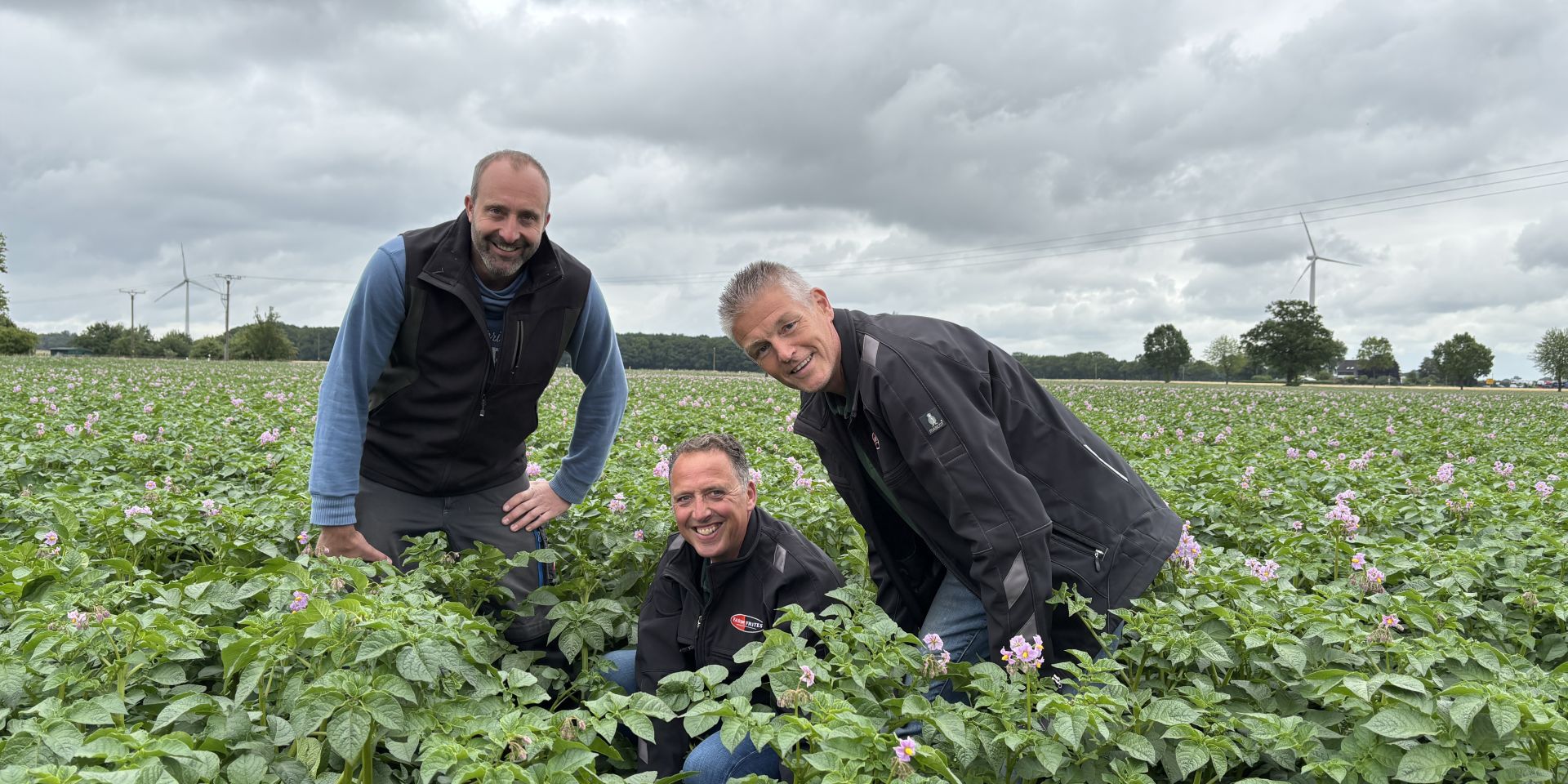
Quintera excels on light sandy soils
ScrollQuintera is proving itself as a strong performer in the early processing segment. After four years of cultivation experience near Kevelaer, Germany, the variety has demonstrated an attractive combination of earliness, high yield potential, and stable processing quality. Experiences from grower Andreas Denissen and Farm Frites show that Quintera is particularly well suited to light sandy soils with irrigation.
At the mixed farming operation of Andreas Denissen, just across the border from Venlo, potatoes cover between 70 and 90 hectares of the farm's 150-hectare acreage. Together with Farm Frites and HZPC, Quintera is being further developed under commercial growing conditions. The first results have highlighted a variety that delivers both in the field and at the factory.

A strong variety for fresh-from-field delivery
Because the potatoes are delivered to Farm Frites directly after harvest, field performance and immediate processing quality are essential. According to Denissen, Quintera's uniform, slightly blocky tuber shape quickly attracted attention, as it contributes to a high cutting yield for French fry production.
Compared with other early processing varieties, yield is one of the variety's key advantages: "On our light sandy soils, provided irrigation is available, we can achieve yields of up to 80 tonnes per hectare," says Denissen.
Strong under warm and dry conditions
The growing season around Kevelaer starts relatively early, with Quintera planting typically taking place at the end of March. On the region's light soils, regular irrigation is often necessary, particularly during periods of warm weather. It is under these circumstances that Quintera has shown its strength, performing well during heat and drought stress and appearing more resilient than other early varieties. According to Denissen, this is partly due to its stronger root system. Quintera has also shown positive performance under disease pressure.
Other early varieties are often susceptible to late blight. With Quintera, there is clearly less concern.
Attention required under cold and wet conditions
While Quintera performs strongly on light sandy soils, successful cultivation starts with the right field conditions. The variety is less suited to heavy clay soils and is sensitive to cold, wet conditions, making planting timing an important consideration.
Planting depth is another key point. Denissen explains: “We had one field with uneven emergence, probably because we planted too deep. Our advice is not to plant deeper than approximately 17 centimetres.”

Efficient nitrogen use
An additional advantage of Quintera is its relatively efficient use of nitrogen. At Denissen's farm, the crop receives around 180 kilograms of total nitrogen, including 80 kilograms supplied through manure. This is approximately 30 kilograms less than the amount applied to other varieties grown on the farm. The ability to maintain performance with lower nitrogen inputs offers clear benefits for growers.
Good frying quality and confidence throughout the supply chain
For Farm Frites, processing quality is the key consideration.The characteristics exhibited by Quintera make it a strong choice for the early French fry market.
Martin Vrij, Agronomy Manager at Farm Frites, sees this combination as one of the variety's major strengths: "Quintera combines an early harvest with sufficient starch content and good frying quality. This makes it highly suitable for early-season French fry production." The stable fry colour straight from the field provides confidence throughout the supply chain, helping growers and processors work with greater predictability. For long-term storage, however, Quintera appears to be less suitable due to quicker development of sugars. “For that reason, we primarily position the variety in the early segment,” explains Vrij.

An excellent fit for light sandy soils
According to Farm Frites’ field observations, Quintera is an excellent choice in areas with light sandy soils, irrigation possibilities and higher disease pressure. “The combination of yield, quality and resistance to internal defects such as rust spot and blackspot bruising makes this variety very well suited to these conditions,” says Bart Laemers, Field Representative at Farm Frites.
A strong fit for modern potato production
As demand for reliable early-season potatoes continues to increase, Quintera offers a combination of characteristics that align with current industry needs. High yields, consistent quality and strong performance under extreme weather conditions make the variety a valuable option for growers targeting the early processing market. Denissen has a clear final message for fellow growers: “On light soils with irrigation, this is simply a very strong variety. Pay close attention to planting depth and avoid cold, wet conditions. If you do that, Quintera can really make a difference.”
For farms operating within these conditions, Quintera has demonstrated that it can consistently deliver from field to factory.

